The pain: paid media is giving up the old control panel
A paid media operator in our internal editorial notes put the mood bluntly this week: advertisers are losing manual control faster than expected. The public signal showed up soon after, when Kazuma Hattori shared Google’s line that Display ads now have “a new home in Demand Gen.” That wording matters. For years, many DTC teams treated Display as a separate lever: prospecting here, remarketing there, placements somewhere else, creative swaps on a familiar schedule.
That mental model is getting weaker. Google is not saying advertisers can no longer reach the Display Network. It is saying the workflow is moving into a campaign type built around AI-assisted audience discovery, creative assembly, and cross-surface delivery.
What changed: Display is moving inside Demand Gen
Google’s announcement says Display advertisers can still serve ads exclusively on the Google Display Network, while managing those campaigns through Demand Gen. Google Ads Help describes the integration as a way to bring the Google Display Network into Demand Gen campaigns.
For operators, this changes where decisions get made. The old question was often, “Which placement, audience, bid, or creative should we adjust?” The new question is closer to, “What inputs are we giving the system, and can we trust the system’s read on the buyer?”
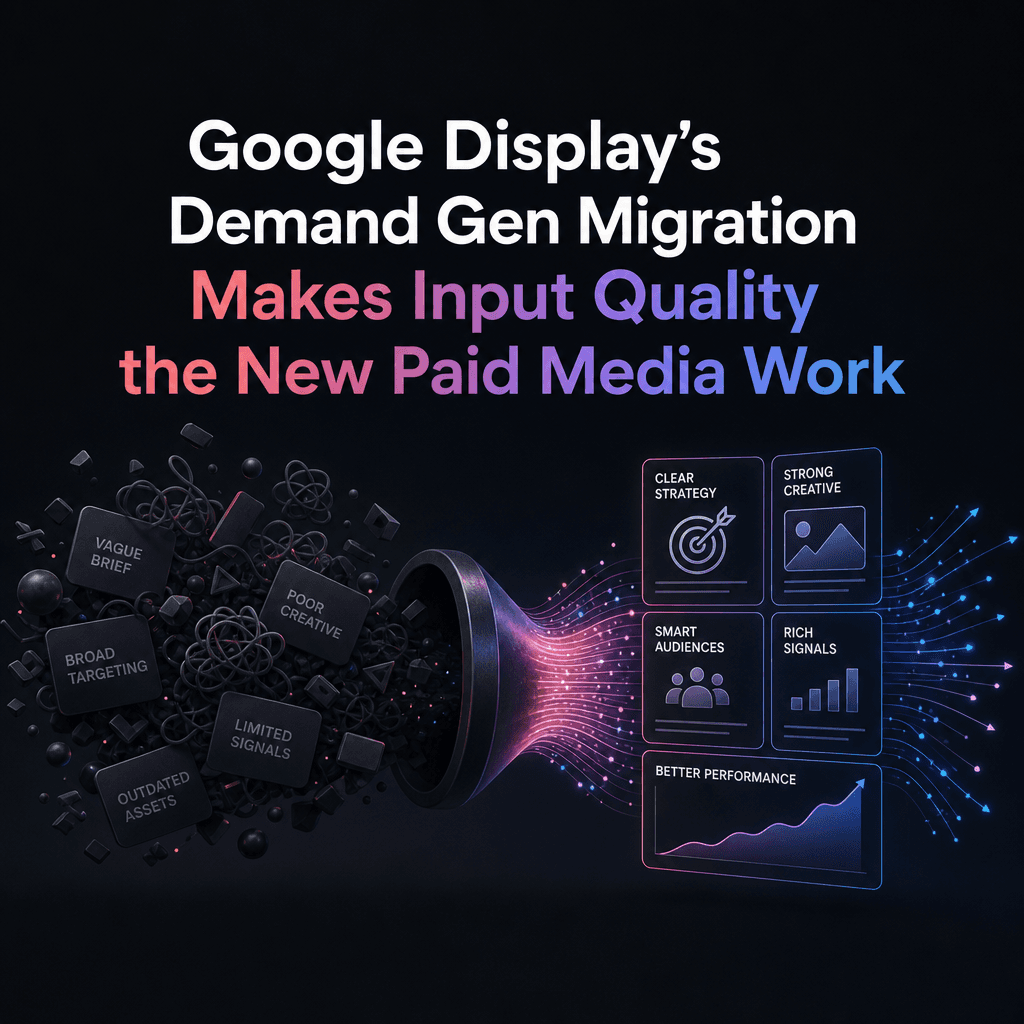
For DTC teams running lean, this is uncomfortable. Manual knobs feel safe because they are visible. But visible is not the same as effective. If the campaign type is doing more of the matching, the operator’s job shifts toward feed quality, creative clarity, landing page promise, and post-click signal.
The operator lens: your inputs matter more when the platform chooses the path
Demand Gen campaigns are built for visual, multi-surface demand creation across Google properties. In practice, that means the platform is reading more than a bid and a target audience. It is reading the product, the creative, the landing page, the conversion event, and the pattern of early engagement.
This is where many ecommerce accounts quietly break. The campaign may have enough budget to spend, but not enough clean information to learn. A product title is vague. A landing page promises one thing and the ad says another. Creative variants are visually different but strategically identical. The conversion event is too far down the funnel for a young campaign to read quickly.
When that happens, AI-assisted media buying does not feel magical. It feels random. The problem is often not that Google’s system cannot optimize. The problem is that the account is asking it to optimize from messy inputs.
What we would check before adding budget
Because Google’s Display migration pushes more work into Demand Gen, we would not start by asking whether the brand needs more creatives or more spend. We would start with four checks.
First, does each product have a clear commercial angle in the feed beyond the catalog label? Second, does each creative speak to one buyer job, or is it trying to explain the whole brand at once? Third, does the landing page repeat the same promise the ad made? Fourth, is the conversion signal close enough to purchase intent that the campaign can learn before the budget gets noisy?
These are boring checks. That is why they are useful. When platform control moves away from the operator, the controllable work becomes cleaner input design. The brands that win will not be the ones that click the most settings. They will be the ones that make the machine’s job easier.
Where Auxora fits
This is the shift we are building Auxora around. We do not think DTC operators need another dashboard full of knobs. They need a calmer way to check whether Meta, Google, creative, landing pages, and offer logic are telling the same story.
Our view is simple: if AI is choosing more of the route, the operator needs a better pre-flight checklist. Auxora helps teams audit the inputs before the spend compounds the mistake. If you want to see where your paid growth system is giving the platforms mixed signals, run a free GTM report and let us look at the account like operators, not spectators.
Sources
- X post by Kazuma Hattori @KazumaHattori, May 27, 2026 - verified with xurl: 1 likes, 0 bookmarks, 79 impressions
- Google: "Google Display Ads is migrating to Demand Gen"
- Google Ads Help: "Google Display Network integration with Demand Gen"
- Google Ads Help: "About Demand Gen campaigns"