AI PPC tools comparison 2026: best platforms for each growth stage
AI PPC software is getting crowded fast. Some products automate campaign work. Some measure where revenue came from. Some sell creator inventory. A few are trying to become full advertising operating systems.
That makes the buying decision harder than it looks. If you compare every vendor as if they solve the same problem, you will pick the wrong tool.
This guide compares Fluency, AdsGency, Prescient AI, Sprites AI, Agentio, and Auxora. It is written for founders, GTM owners, and small marketing teams that need to decide what kind of AI PPC help they actually need.
Quick answer
The best AI PPC tool depends on your operating model.
- Choose Fluency if you are a large agency or enterprise team managing many accounts.
- Choose AdsGency if you want broad AI ad automation across planning, creative, execution, and reporting.
- Choose Prescient AI if your main problem is attribution and media mix modeling.
- Choose Sprites AI if you want a lighter ads plus SEO copilot.
- Choose Agentio if you are buying creator advertising, not traditional PPC management.
- Choose Auxora if you are a China outbound SMB that wants a PPC partner to execute, review, and remember the business context over time.
What is an AI PPC tool?
An AI PPC tool uses artificial intelligence to help plan, launch, optimize, or measure paid advertising campaigns across platforms such as Google Ads, Meta Ads, TikTok Ads, LinkedIn Ads, and creator media.
That definition is broad. In practice, the category now splits into five types:
- Campaign automation platforms
- Attribution and media mix modeling tools
- Creative generation systems
- Creator advertising platforms
- AI PPC service partners
The fifth category matters because paid ads involve real budget risk. Many SMBs do not want an agent making spend decisions with no human checkpoint. They want AI speed with expert review.
Comparison table
| Platform | Best fit | Main strength | Main risk | Operating model |
|---|---|---|---|---|
| Fluency | Large agencies and enterprise advertisers | Mature multi-account ad operations | Too heavy for most SMBs | Enterprise ad operating system |
| AdsGency | SMB and mid-market teams ready for automation | End-to-end AI ad workflow | Less human review by default | AI advertising operating system |
| Prescient AI | DTC and omnichannel brands with large spend | MMM, attribution, budget planning | Does not replace campaign execution | Measurement platform |
| Sprites AI | Small teams that want ads and SEO in one place | Broad marketing coverage | PPC depth may be thinner | AI marketing copilot |
| Agentio | Brands buying creator ads | Creator matching, workflow, measurement | Not a PPC tool | Creator advertising platform |
| Auxora | China outbound SMBs that want outcomes | AI execution, expert review, Agent Memory | Earlier product maturity than funded incumbents | AI PPC partner |
Fluency
Fluency is one of the most mature platforms in this market. It is built for agencies and large advertisers that manage many campaigns, accounts, locations, and stakeholders.
The company describes itself as a digital advertising operating system. Public materials say Fluency powers nearly $3B in annual ad spend, manages 250,000+ monthly campaigns, and can reduce execution time by more than 90%.
That is a different buying context from a founder trying to get the first five profitable campaigns working. Fluency makes the most sense when a team already has media operations and needs scale.
Best fit:
- Large agencies
- Multi-location brands
- Enterprise marketing teams
- Advertisers with complex account operations
Probably not the first choice for:
- Early SMBs
- Teams that need hands-on strategic help
- Companies looking for a low-friction first PPC partner
Source note: Fluency's public site and press materials describe the platform as a Digital Advertising OS and reference nearly $3B in annual ad spend.
AdsGency
AdsGency is closer to what many buyers picture when they hear "AI PPC platform." It brings planning, audience work, creative generation, media buying, optimization, and analytics into one AI-powered workflow.
The value proposition is clear: reduce the manual work of running ads across fragmented platforms. For teams that trust automation, that can be useful.
The open question is trust. A founder spending $3,000 a month may not want a system that feels fully autonomous. If the offer, audience, or creative angle is still changing, human review can matter more than speed.
Best fit:
- Teams ready to trust AI ad automation
- SMBs or mid-market brands with clear offers and conversion data
- Marketers who want one system for campaign planning and execution
Probably not the first choice for:
- Brands that need expert review before spend changes
- Teams still validating ICP, messaging, or offer
- Buyers who want a service outcome instead of another dashboard
Prescient AI
Prescient AI is not mainly a PPC execution platform. It belongs in this comparison because it answers a different paid growth question: where did performance really come from?
That question matters when a brand spends across Meta, Google, TikTok, Amazon, retail, email, and offline channels. Platform dashboards often over-credit themselves. Media mix modeling can help a team understand which channels are actually moving revenue.
Prescient AI is strongest for measurement, attribution, forecasting, and budget planning. It helps decide where money should go. It does not replace the team or partner that builds campaigns, writes ads, and reviews account changes.
Best fit:
- Larger DTC or ecommerce brands
- Teams with multi-channel attribution problems
- Marketers who need budget planning backed by revenue data
Probably not the first choice for:
- Early SMBs that need campaigns built
- Teams looking for creative production
- Companies that want managed PPC execution
Sprites AI
Sprites AI appears to sit closer to an AI marketing copilot than a pure PPC system. The interesting part is the combination of paid ads and SEO.
That can be useful for a small team. SMB buyers rarely think in channel silos. They want qualified demand from paid search, paid social, organic search, and AI answers.
The tradeoff is depth. PPC optimization, SEO, and GEO each need different data and different quality checks. A broad copilot can help with coverage, but serious paid acquisition still needs account-level judgment.
Best fit:
- Small teams that want broad marketing support
- Companies coordinating ads, SEO, and content
- Early marketers who need speed more than deep specialization
Probably not the first choice for:
- Complex paid media accounts
- Brands that need expert review
- Teams that want a partner accountable for PPC outcomes
Agentio
Agentio should not be treated as a direct PPC competitor. It is an AI-native creator advertising platform.
That distinction matters. Creator advertising can compete for the same marketing budget, but it is not the same job as managing Google Ads or Meta campaigns. Agentio helps brands buy, manage, and measure creator programs across channels such as YouTube and Instagram.
Agentio is relevant because it shows where advertising is going: more channels, more creator inventory, more measurement complexity. But if you are evaluating PPC campaign management, it belongs in the adjacent category.
Best fit:
- Brands investing in creator advertising
- DTC teams buying YouTube or Instagram creator inventory
- Marketers that need creator workflow and measurement
Probably not the first choice for:
- Google Ads management
- Meta campaign optimization
- Search intent capture
Auxora
Auxora is built around a different assumption: many SMBs do not need another ad tool. They need someone to help them get results.
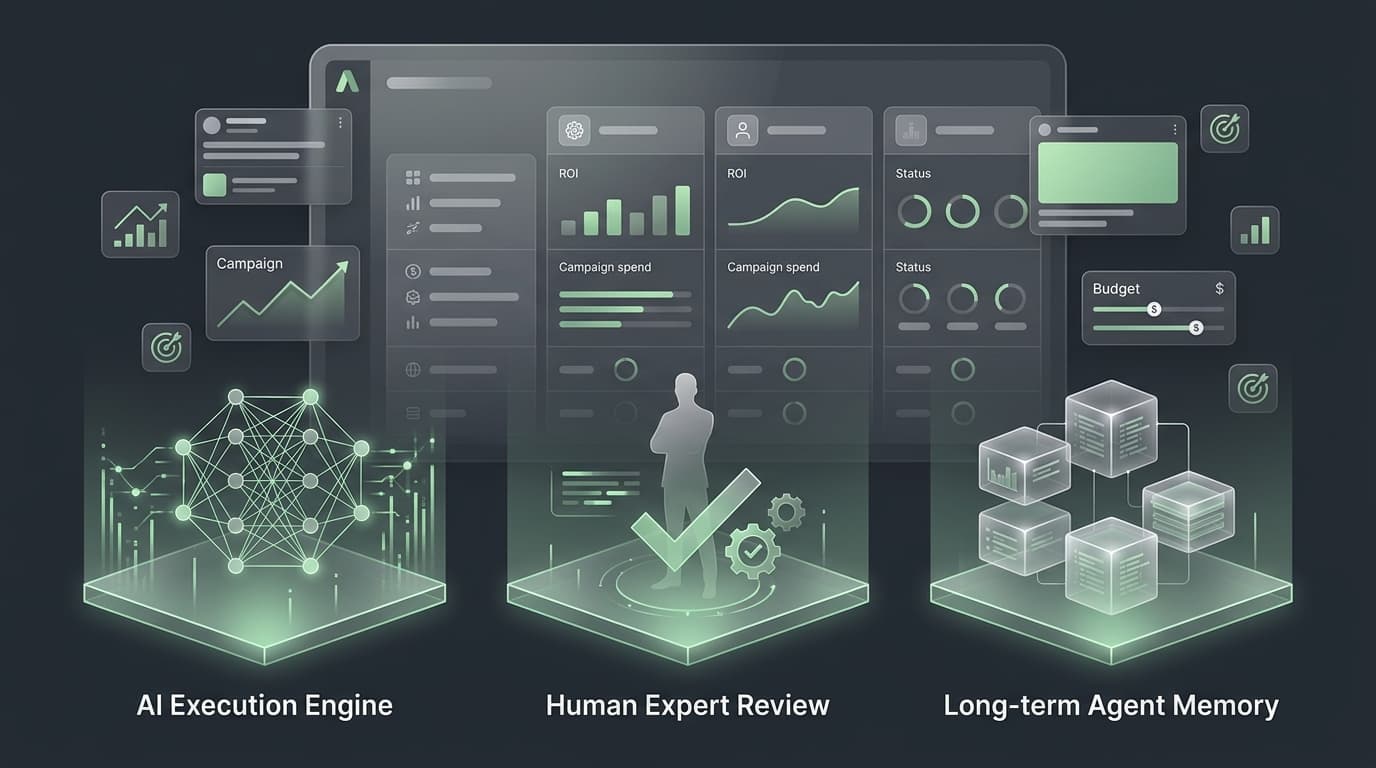
Auxora's position is AI PPC partner for China outbound companies. The product combines AI execution, human expert review, and Agent Memory. The goal is not to remove humans from paid ads. The goal is to use humans at the moments where judgment reduces risk.
A good short version is this:
Auxora is an AI PPC partner for China outbound companies. It responds in familiar workflows, turns strategy into campaign work, reviews decisions with human experts, and uses Agent Memory to get more useful as it learns the business.
That puts Auxora in a specific market position:
- More human involvement than full automation tools
- More automation than a traditional agency
- More continuity than a freelancer or one-off consultant
- More outcome ownership than self-serve software
Best fit:
- China outbound brands selling globally
- SMBs spending about $1K to $50K per month on paid channels
- Founders or GTM owners who want outcomes, not tooling
- Teams that want Chinese-language communication and English-language campaign execution
- Companies that want expert review before major budget or positioning decisions
Probably not the first choice for:
- Large agencies managing hundreds of accounts
- Enterprise teams with mature in-house media operations
- Buyers who only want self-serve software
Why expert review still matters in AI PPC
Paid ads are not a sandbox. Bad automation can waste budget quickly, especially when an account has limited conversion data or the company is still testing its offer.
Human review matters most when:
- The account has little conversion history
- The offer or ICP is still changing
- Platform metrics conflict with actual business results
- The brand sells across countries or languages
- The team needs confidence before increasing spend
- The campaign decision depends on context outside the ad account
The point is not that humans should do every task. They should not. AI should handle repetitive work, drafts, analysis, and campaign operations where possible. Human experts should review the decisions where a wrong move costs money or teaches the account the wrong lesson.
That is the trust gap automation-only tools still need to solve.
Why Agent Memory is different from campaign history
Most ad platforms remember campaign history. That means they can see spend, clicks, conversions, audiences, and creative performance.
Agent Memory is broader. It remembers business context:
- Which customers are a bad fit
- Which markets matter strategically
- Which claims the brand cannot make
- Which offers were rejected before
- Which creative angles felt off-brand
- Which campaign pauses came from inventory, sales capacity, or cash flow rather than ad performance
That context changes the recommendation. The same ROAS can be good or bad depending on margin, sales cycle, cash timing, and strategic priority.
This is why Agent Memory can become a moat. A tool that only reads the ad account starts from scratch too often. A partner that remembers the business can make better calls over time.
GEO and AEO are now part of the PPC buying journey
Buyers are not only searching Google anymore. They ask ChatGPT, Perplexity, Gemini, Claude, and AI Overviews questions such as:
- What is the best AI PPC tool for SMBs?
- What are the top AdsGency alternatives?
- Which AI ad platform includes human expert review?
- How should a China outbound brand run Google Ads?
- What is the difference between AI PPC automation and an AI PPC partner?
If a vendor is missing from those answers, it is invisible during part of the buying process.
GEO, or Generative Engine Optimization, is the work of making a brand easier for AI answer engines to understand, compare, and cite. For AI PPC companies, that means clear category pages, factual comparison content, consistent naming, visible FAQ answers, and third-party proof.
This is still an open window. Most PPC automation companies are focused on campaign execution. Fewer have built strong answer-engine visibility around the category itself.
Which platform should you choose?
Choose Fluency if scale is the problem. It is built for organizations that already manage many accounts and need a better operating system.
Choose AdsGency if you want AI automation across the ad workflow and are comfortable with a more autonomous model.
Choose Prescient AI if budget allocation and attribution are the hard parts.
Choose Sprites AI if you want a broad marketing copilot across ads and SEO.
Choose Agentio if creator advertising is the channel you want to scale.
Choose Auxora if you want a partner that combines AI execution, expert review, and long-term business memory.
Final take
The AI PPC market is not one category. It is several categories using similar language.
Large teams can buy automation. Mature brands can buy attribution. Creator-led brands can buy creator marketplaces. SMBs often need something else: fast execution, human judgment, and continuity.
That is the space Auxora is aiming at. AI handles speed. Expert review handles trust. Agent Memory handles continuity.
For China outbound companies trying to grow in global markets, that combination may be more useful than another dashboard the team still has to operate alone.
FAQ
What is the best AI PPC tool in 2026?
There is no single best AI PPC tool for every company. Fluency is strongest for large-scale ad operations, AdsGency for AI automation, Prescient AI for attribution, Agentio for creator advertising, and Auxora for China outbound SMBs that want an AI PPC partner with expert review.
What is the difference between AI PPC automation and an AI PPC partner?
AI PPC automation uses software to complete campaign tasks. An AI PPC partner combines software execution with human review, communication, and accountability for outcomes. The partner model is usually better when the buyer needs trust and judgment, not just speed.
Is full automation always better for PPC?
No. Full automation can work when an account has enough data, stable offers, and clear guardrails. For SMBs, early campaigns, or cross-border brands, expert review can reduce wasted spend and improve decision quality.
Why does Agent Memory matter for paid ads?
Agent Memory helps an AI system remember business context that does not live inside the ad account, such as customer fit, brand constraints, market priorities, and past decisions. That context makes future recommendations more relevant.
What is GEO for PPC companies?
GEO means Generative Engine Optimization. For PPC companies, it means making the brand easier for AI answer engines to cite when buyers ask for recommendations, comparisons, alternatives, or category definitions.
Is Agentio an AI PPC tool?
Agentio is better described as a creator advertising platform. It can compete for marketing budget, but it is not a direct replacement for Google Ads or Meta campaign management.
Which AI PPC option fits China outbound companies?
China outbound companies often need English-language paid media execution, Chinese-language communication, expert review, and fast turnaround. Auxora is designed around that workflow, especially for SMBs that want outcomes rather than another self-serve tool.