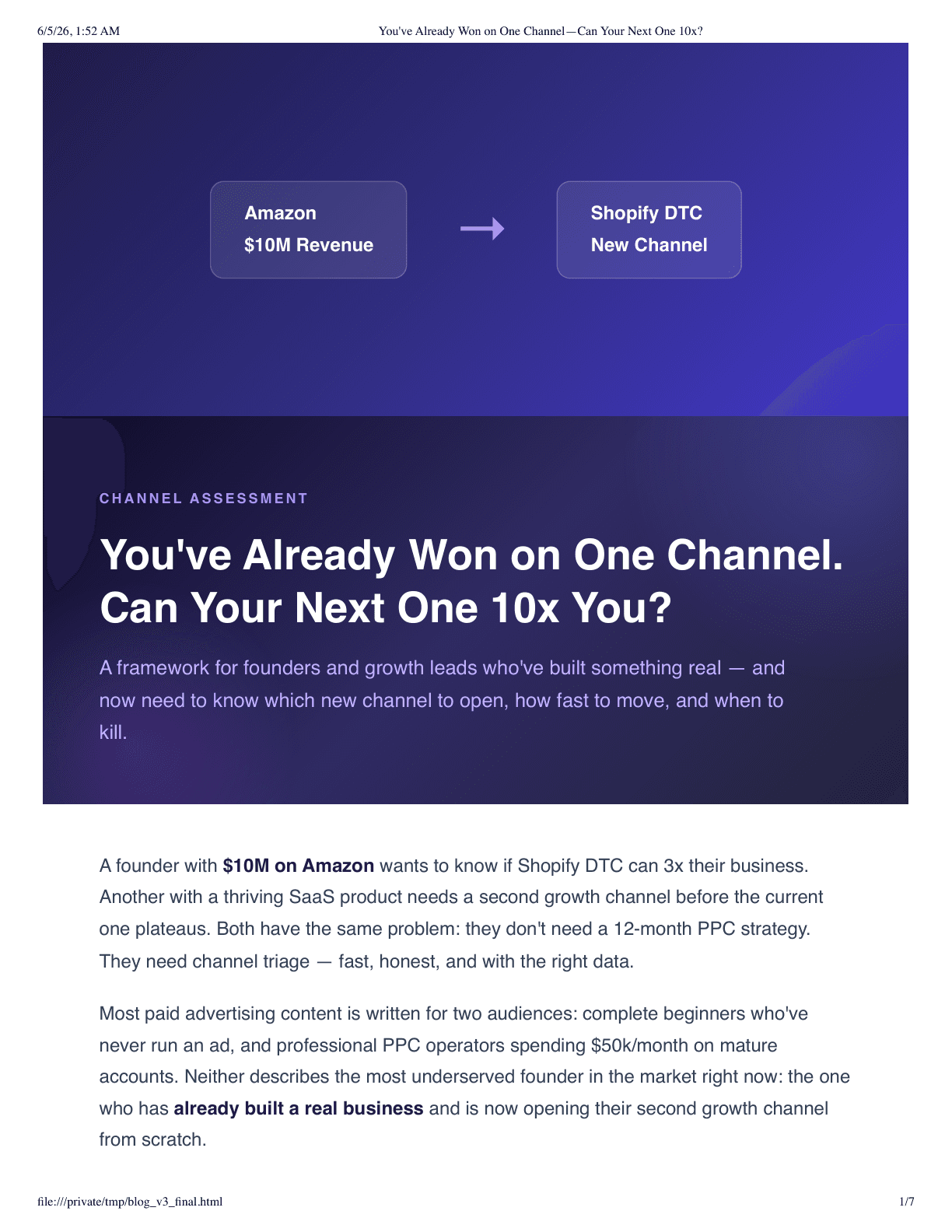
A founder with $10M on Amazon wants to know if Shopify DTC can 3x their business.
Another founder with a thriving SaaS product needs a second growth channel before the current one plateaus.
Both have the same problem: they do not need a 12-month PPC strategy. They need channel triage: fast, honest, and with the right data.
Most paid advertising content is written for two audiences: complete beginners who have never run an ad, and professional PPC operators spending $50k/month on mature accounts. Neither describes the most underserved founder in the market right now: the one who has already built a real business and is now opening their second growth channel from scratch.
This founder has budget, usually $3k-$30k/month. They have operational maturity. What they do not have is a framework for answering the one question that matters: is this channel going to 10x me, or is it going to burn my money and my team's attention for six months before I find out?
Stop Asking "Does PPC Work?" Start Asking "What's the Floor and Ceiling?"
Most founders ask a single binary question when evaluating a new channel: "Can this work for us?"
But "can it work" is the wrong question because every channel can work for someone. The right questions are sequential:
- What is the floor? If I put $3,000 into this channel over four weeks, what is the worst-case signal I will get? Not worst-case ROAS. Worst-case information. Will I at least know if there is something here?
- What is the ceiling? If everything goes right, what does this channel cap out at? Is the ceiling $30k/month in profitable spend, or $300k/month?
- What is the speed? How fast can I get from floor signal to ceiling signal? Four weeks, twelve weeks, or six months?
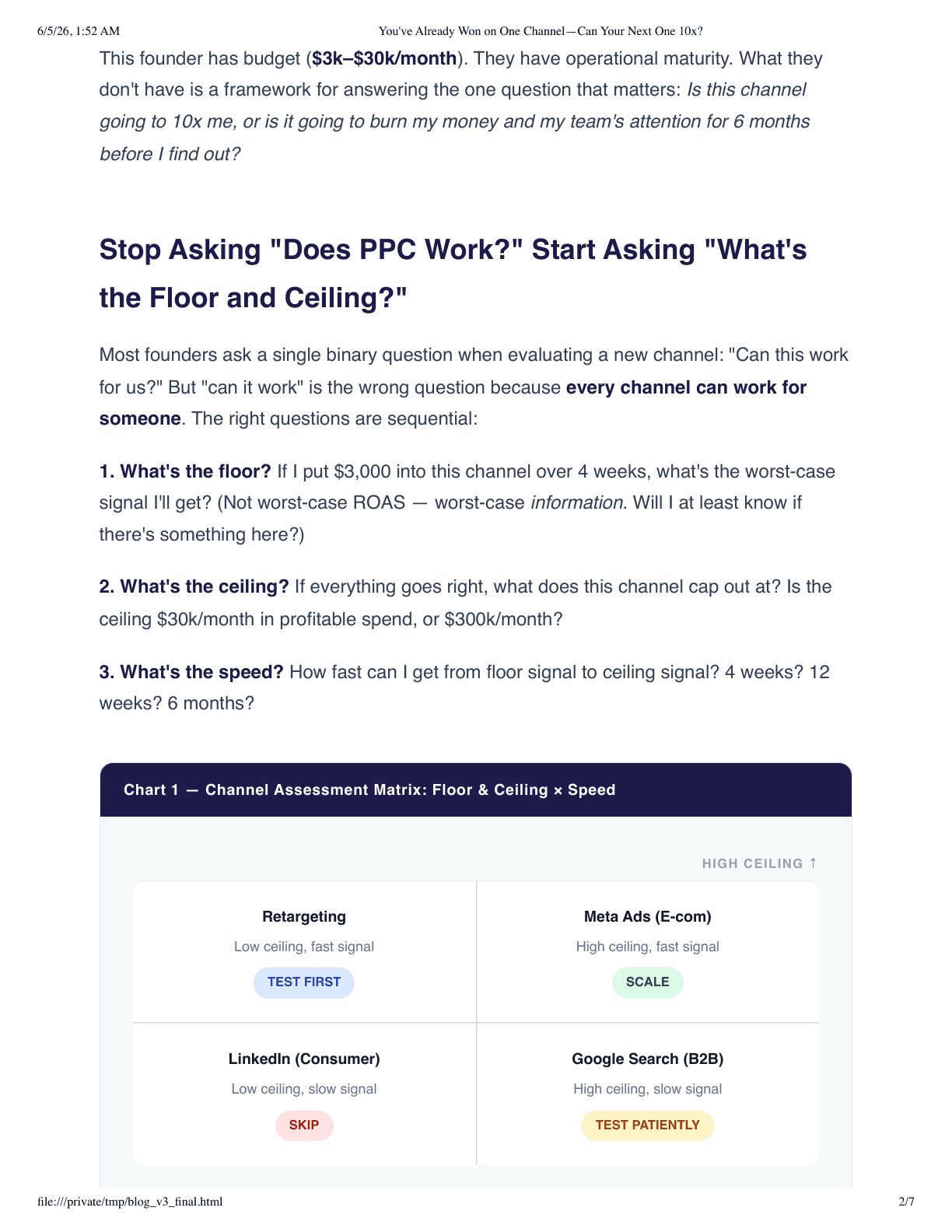
A channel with a high ceiling but a six-month learning curve might be the right answer for a stable SaaS business. It is the wrong answer for a founder whose business model has a 12-month competitive window.
Same channel, different founders, opposite recommendations, because channel assessment is personal to your timeline.
The 4 Components Your Agency Won't Debug
A founder who scaled a business to $20M+ ARR through paid ads told us: "Four things have to align for paid to scale: creative, product funnel, landing page CVR, and campaign structure. If one breaks, everything breaks. And agencies only touch the last two."
This explains why so many founders' first PPC test fails, and why it is not actually a PPC failure at all.
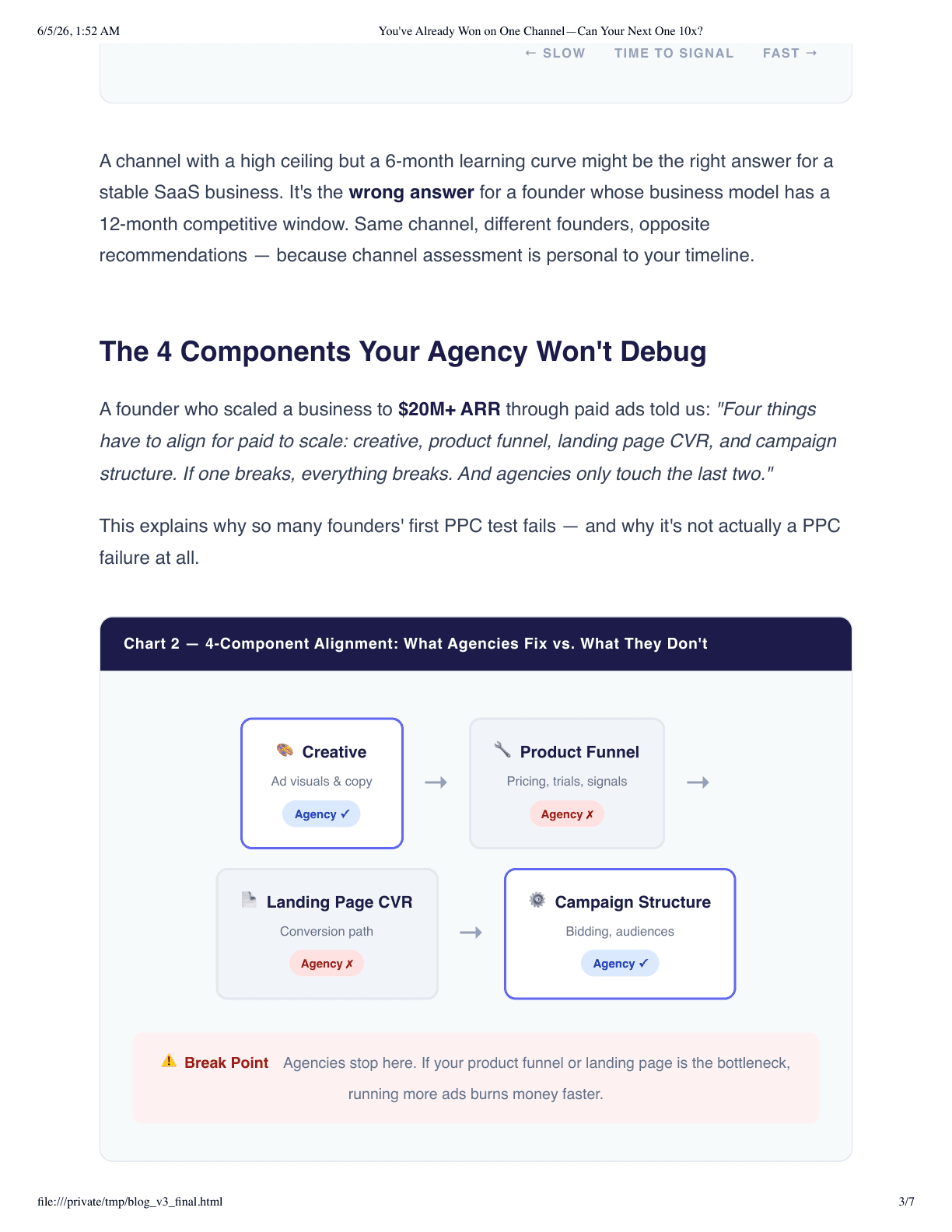
Creative is the ads themselves. Agencies handle this.
Product funnel is your pricing, trial design, payment points, and data signals flowing back to the ad platform. If you have a seven-day free trial, Meta's attribution window may not see the signal in time. If your price point distribution is narrow, value-based bidding is weak. These are product decisions that look like ad problems.
Landing page CVR is the App Store page, Shopify landing page, or website conversion path. If your landing page converts at 1% and your competitor's converts at 4%, you need 4x the ad spend to get the same result. No agency fixes your landing page by default.
Campaign structure is ad sets, bidding strategies, and audience targeting. This is what agencies actually control.
Most founders hire an agency to optimize campaigns, then wonder why performance does not improve when the bottleneck was product funnel design or landing page CVR all along. The agency never told them because the agency does not touch those layers.
Why 0.5 ROAS Is a Good Signal When You Know What You're Buying
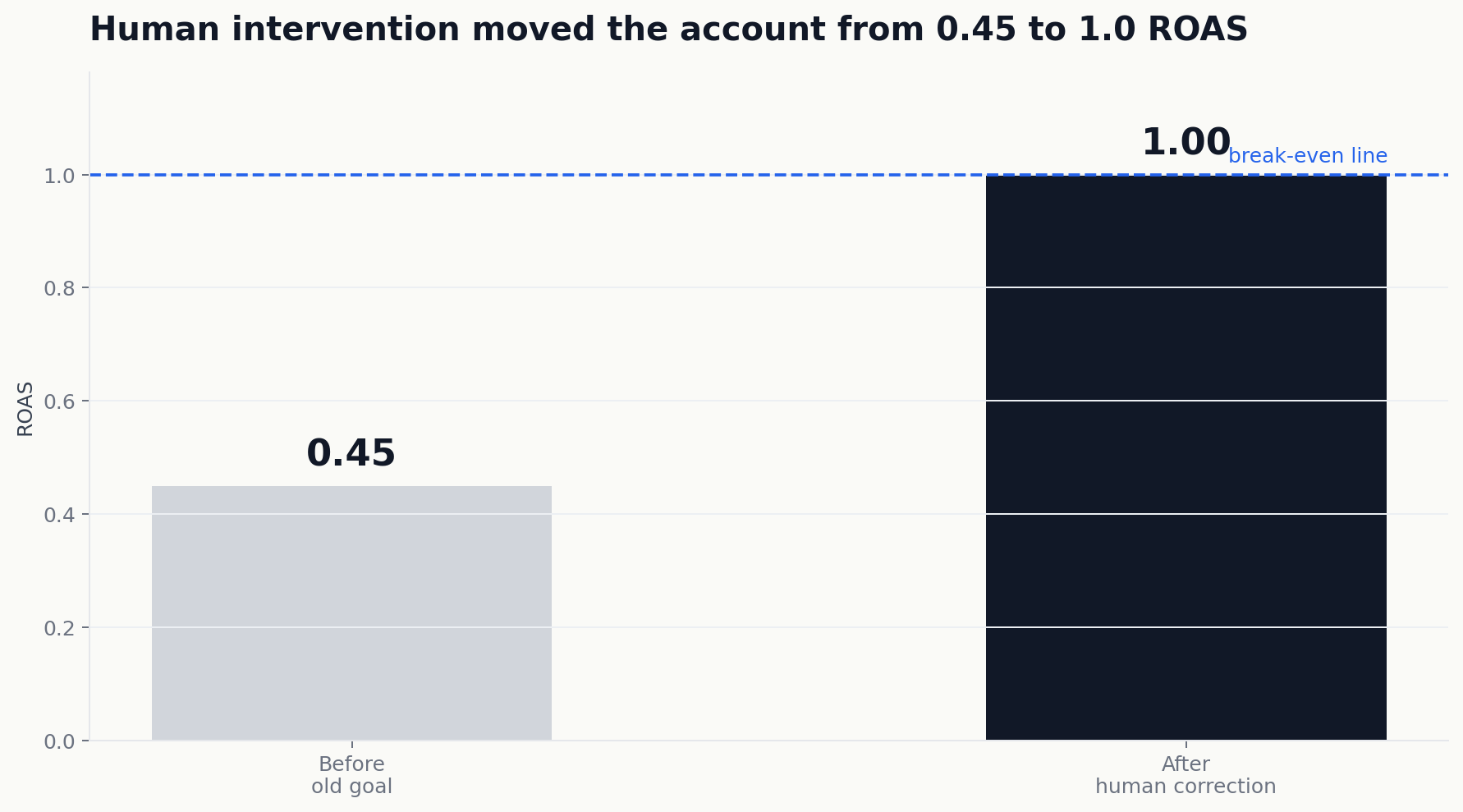
Here is a truth that goes against every PPC tutorial: in the first four to six weeks of testing a new channel, ROAS below 1.0 is not a failure. It is the cost of information.
The real question is not "Is ROAS above 1.0?" It is "Is the curve bending in the right direction?"
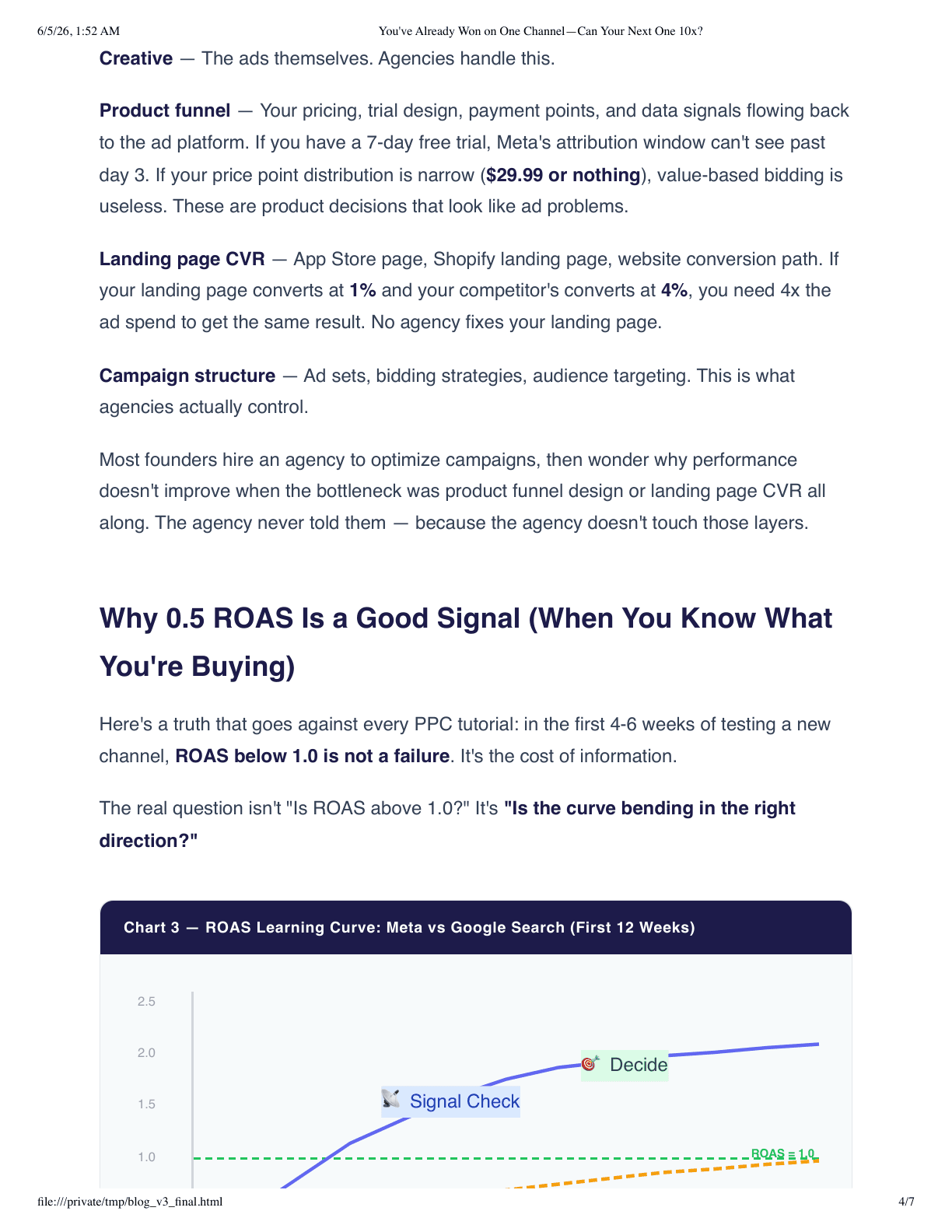
A founder testing Meta ads might see:
- Week 1-2: 0.3 ROAS. Audience learning, no conversion data.
- Week 3-4: 0.5 ROAS. First conversions feeding back.
- Week 5-6: 0.8 ROAS. Audience narrowing, creative iterations landing.
- Week 7-8: 1.2 ROAS. Learning complete, scaling begins.
If week four shows 0.5 ROAS but the slope is upward and accelerating, that is a buy signal.
If week eight shows 0.5 ROAS and the curve is flat, it is time to kill the channel or diagnose the product-layer bottleneck.
The founders who burn the most money are not the ones who test aggressively. They are the ones who test indecisively, keeping a flat channel alive for twelve weeks because they do not know what a real signal looks like.
The Horse-Racing Principle: Why One Agency Is Not Enough
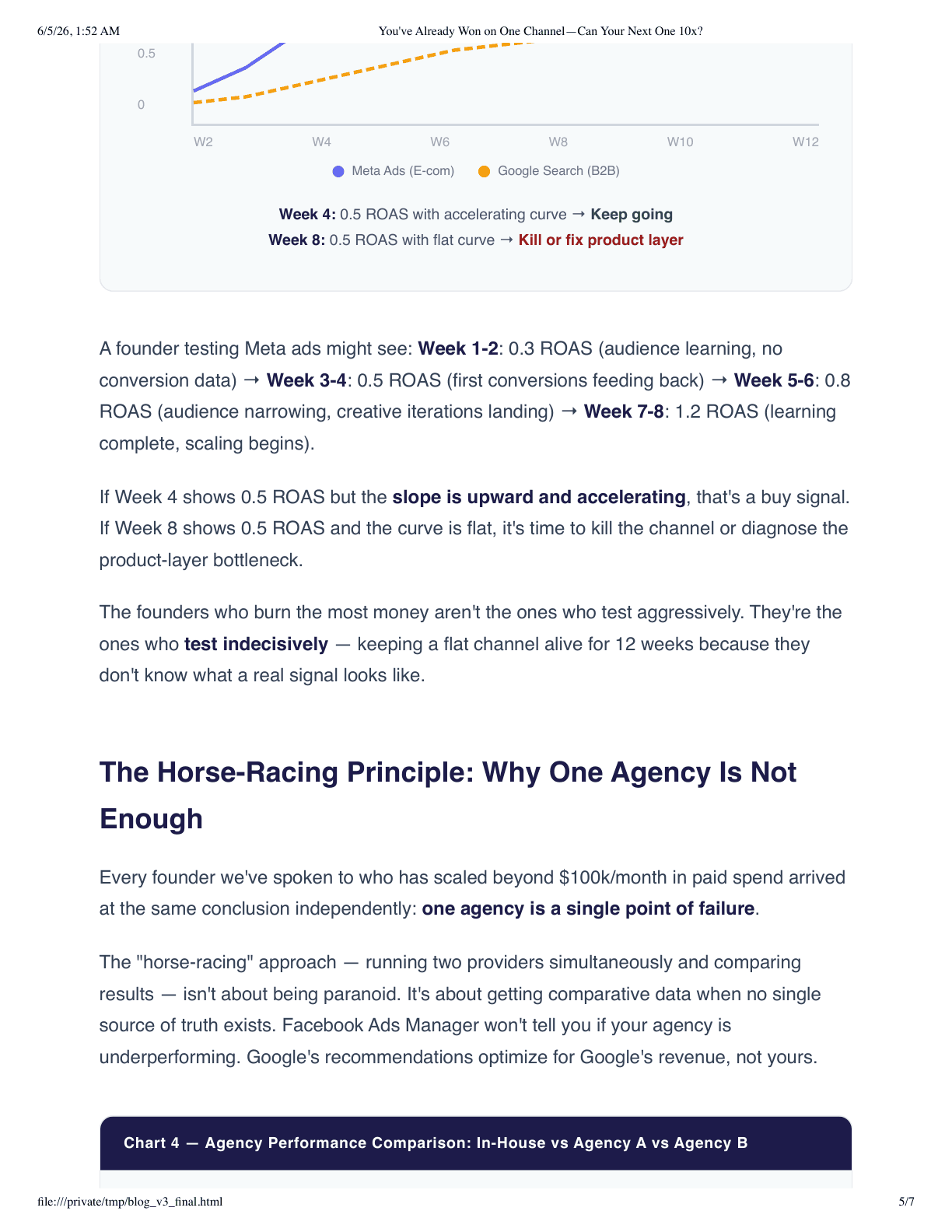
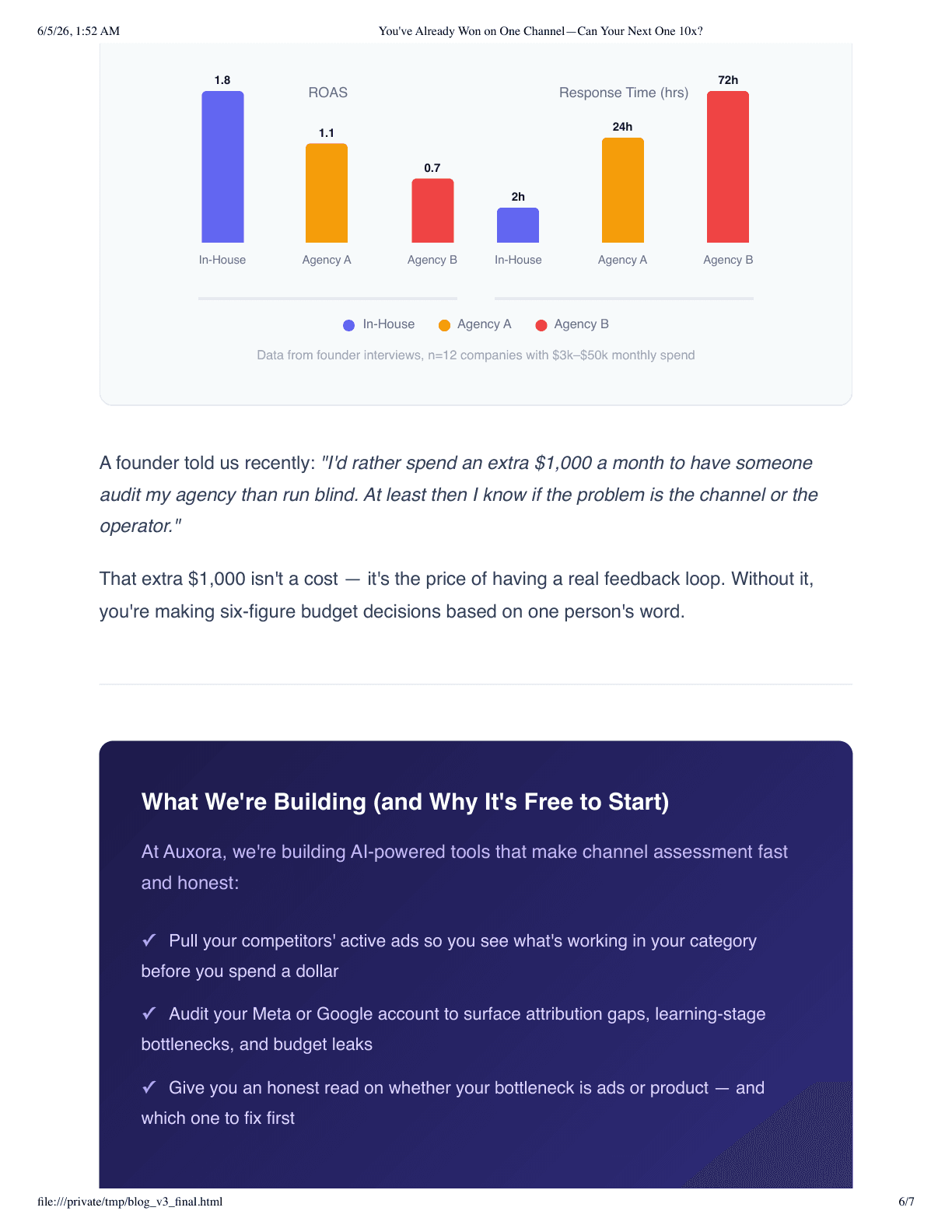
Every founder we have spoken to who has scaled beyond $100k/month in paid spend arrived at the same conclusion independently: one agency is a single point of failure.
The horse-racing approach, running two providers simultaneously and comparing results, is not about being paranoid. It is about getting comparative data when no single source of truth exists.
Facebook Ads Manager will not tell you if your agency is underperforming. Google's recommendations optimize for Google's revenue, not yours.
A founder told us recently: "I'd rather spend an extra $1,000 a month to have someone audit my agency than run blind. At least then I know if the problem is the channel or the operator."
That extra $1,000 is not a cost. It is the price of having a real feedback loop. Without it, you are making six-figure budget decisions based on one person's word.
What We're Building and Why It's Free to Start
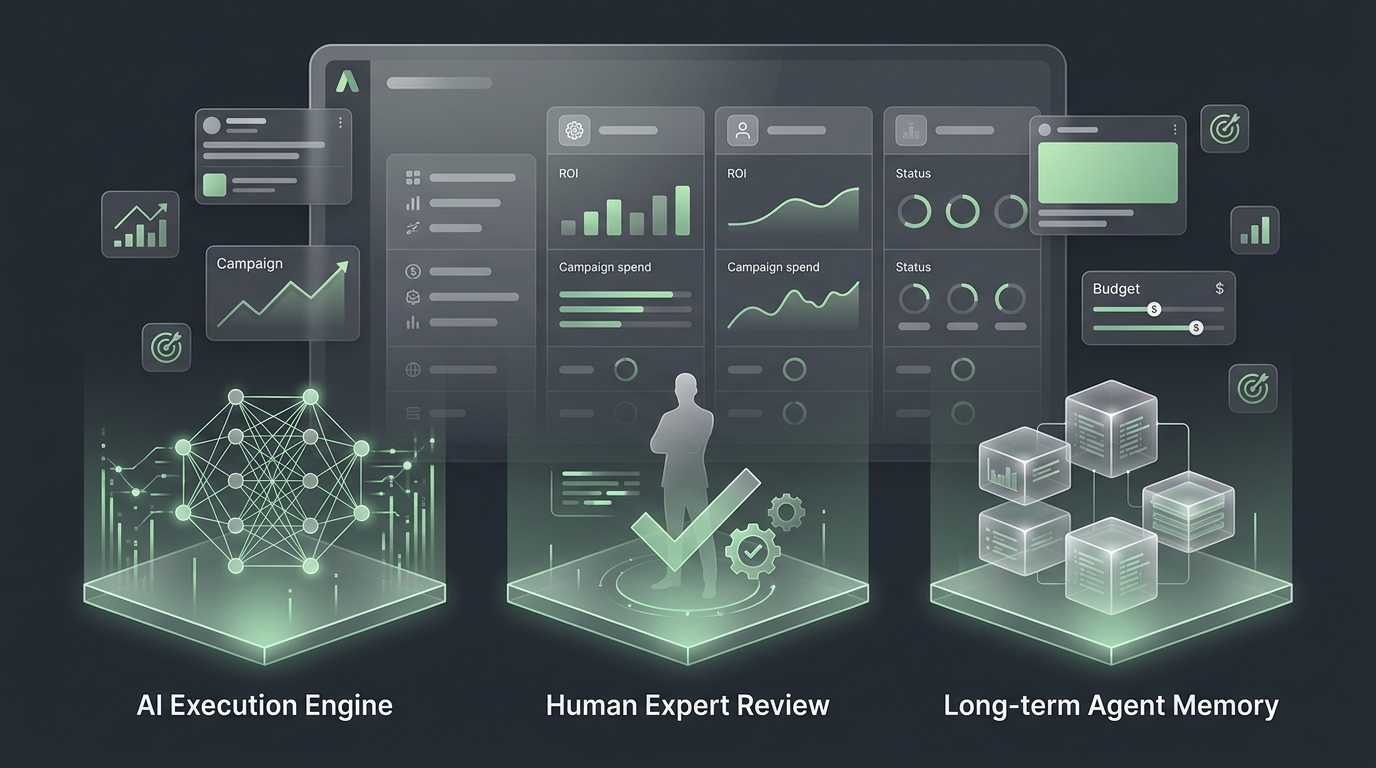
At Auxora, we are building AI-powered tools that make channel assessment fast and honest:
- Pull your competitors' active ads so you see what is working in your category before you spend a dollar.
- Audit your Meta or Google account to surface attribution gaps, learning-stage bottlenecks, and budget leaks.
- Give you an honest read on whether your bottleneck is ads or product, and which one to fix first.
If you are a founder or growth lead with $3k-$30k in monthly ad budget testing a new channel, we will do this audit for free. No pitch. No retainer.
We would rather you walk away knowing the truth than burn another quarter guessing.