The account was not broken. Google Ads was just doing the wrong job.
The account did not look broken at first.
It looked like every complicated SaaS account looks when the funnel gets long: some campaigns were fine, some were bleeding, the conversion data was messy, and everyone could explain away one more bad month.
Then the number became hard to ignore.
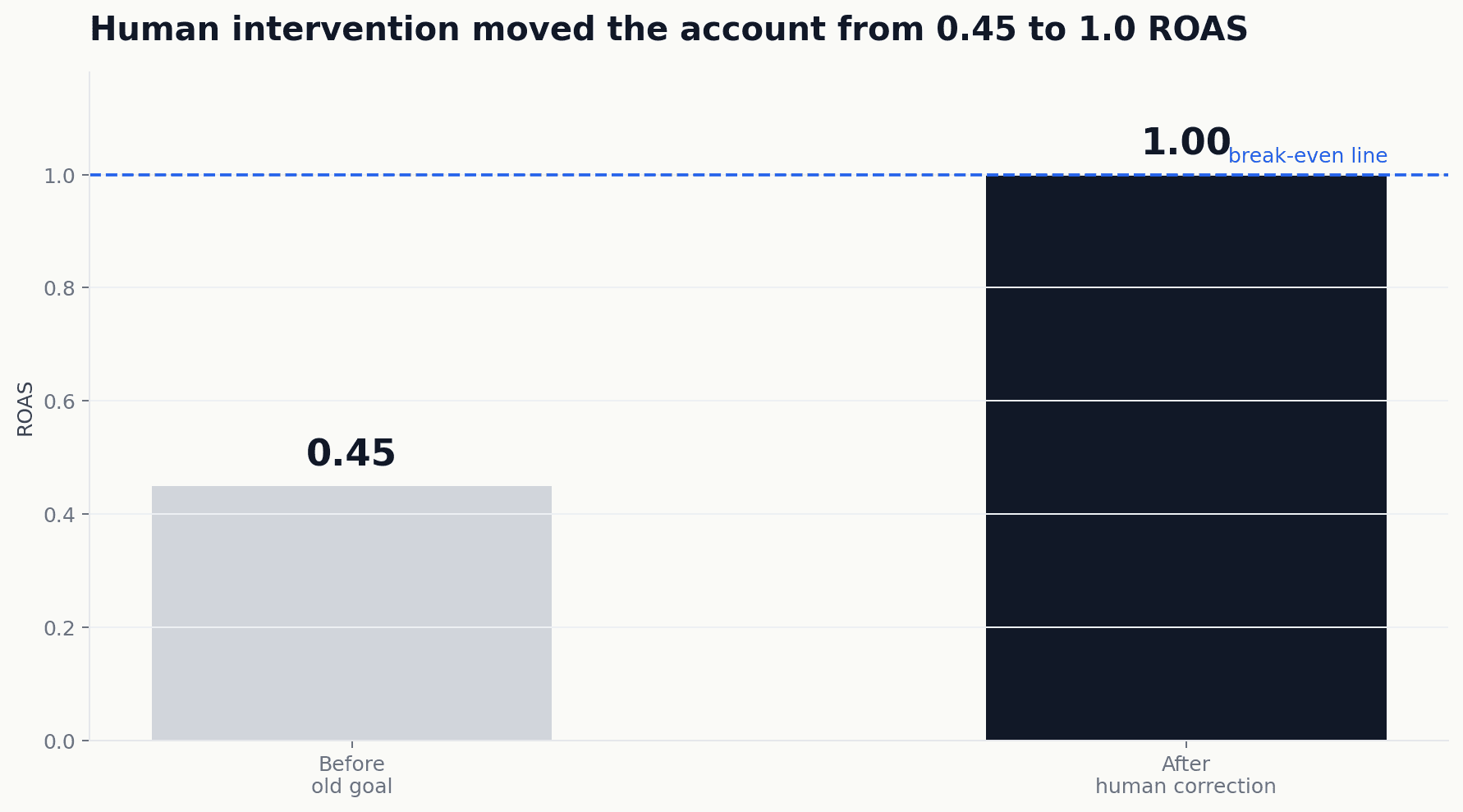
ROAS had fallen to roughly 0.45 in the reviewed window. After the team intervened and changed what the system was optimizing for, the account climbed back to around 1.0.
That jump matters because it was not caused by a prettier ad or a clever bid tweak. It came from a human decision: the old conversion goal had gone stale.
Google Ads was still doing its job. It was just doing the wrong job.
The case came from a mature B2C SaaS brand with a longer funnel than ecommerce. Users might search, register, start a trial, and only later become paid subscribers. That delay makes the account harder to read than a simple purchase funnel.
Inside the same Google Ads account, there were really two businesses.
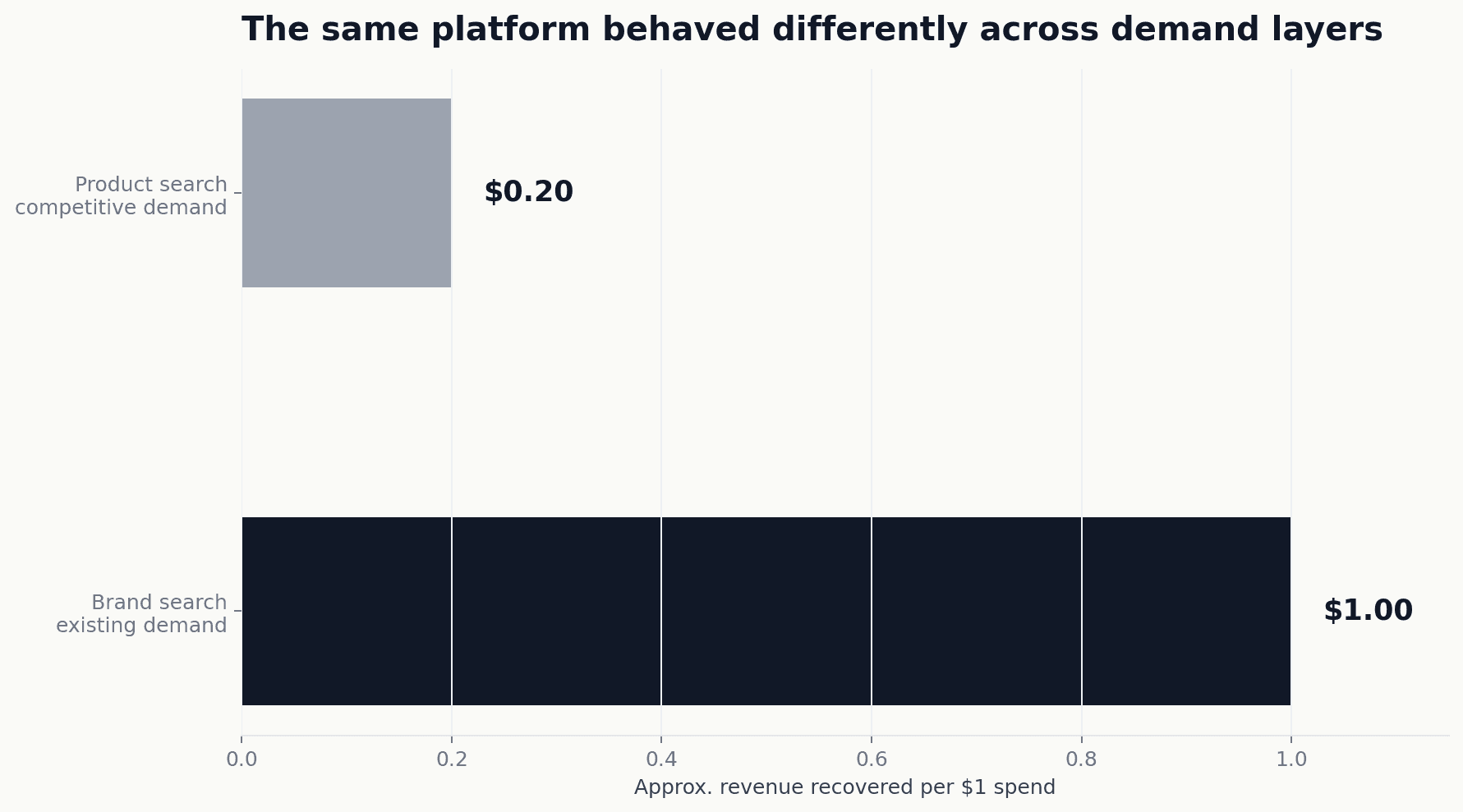
One was branded search. These users already knew the brand. In rough terms, the team could spend $100 and recover around $100.
The other was product search. These users searched broader category terms, such as mind mapping, concept map, or mind mapping tool. That traffic was much more competitive. In rough terms, $100 of spend might recover only $20.
Both campaign types sat inside the same platform. Both produced conversions. But they did not have the same business meaning.
That is where many ad accounts start to fool teams. The dashboard shows activity. The platform finds conversions. The weekly report still has numbers to discuss.
But the business has moved on.
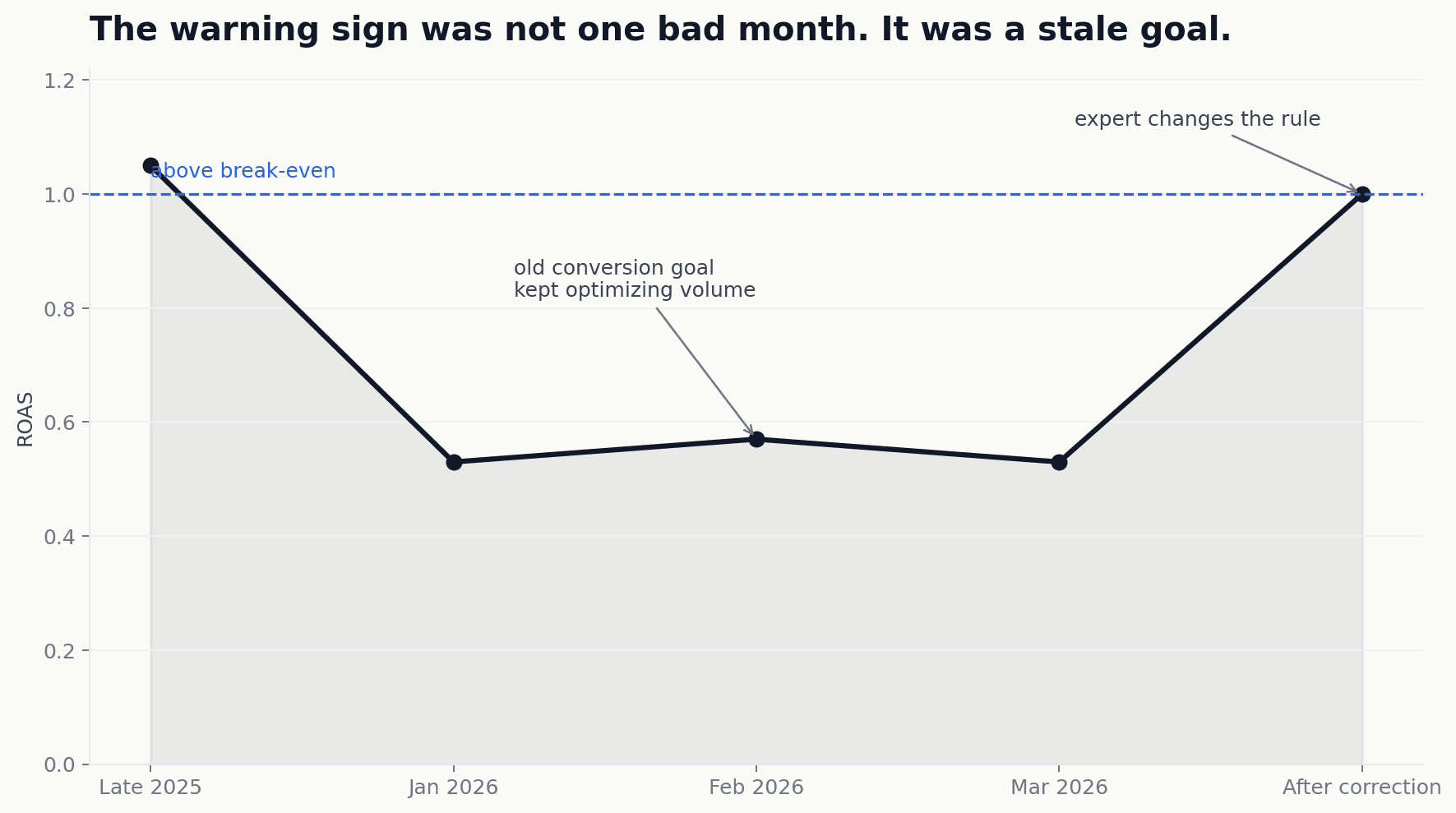
In late 2025, optimizing for more conversion volume still made sense. The account was above 1.0 ROAS in some reviewed periods, and more signups could still feed the funnel.
Then Q1 2026 changed the story.
A January view showed ROAS around 0.53. February was around 0.57. March was also around 0.53 in one later review window. SaaS attribution is never perfectly clean, so no single number should be treated as gospel. But the pattern was clear enough.
The old goal was no longer good enough.
Part of the problem was technical. The SaaS brand had conversions happening across two domains. Because the product site was custom-built, tracking had to be implemented manually. Some conversion events were not being passed back cleanly.
There was also a GDPR-related issue. In Europe, missing privacy and cookie compliance work caused Google to block event feedback for certain markets. Some European campaigns had to pause until the compliance and tracking setup was fixed.
Those fixes were necessary. But they were not the whole answer.
The bigger issue was judgment.
The system was still being rewarded for conversion volume when the business needed higher-quality conversion value. A signup was useful. A trial was better. A paid subscription was better still. Treating those signals too similarly made the platform optimize toward the wrong behavior.
So the team changed the rule.
They moved the account away from chasing the easiest conversion volume and toward the events that were closer to revenue. They separated demand layers more clearly. They cleaned up the signal path. They stopped asking Google to maximize a goal that no longer matched the business.
That is how the account moved from roughly 0.45 ROAS back toward 1.0.
The important lesson is not "humans are better than AI." That is too simple.
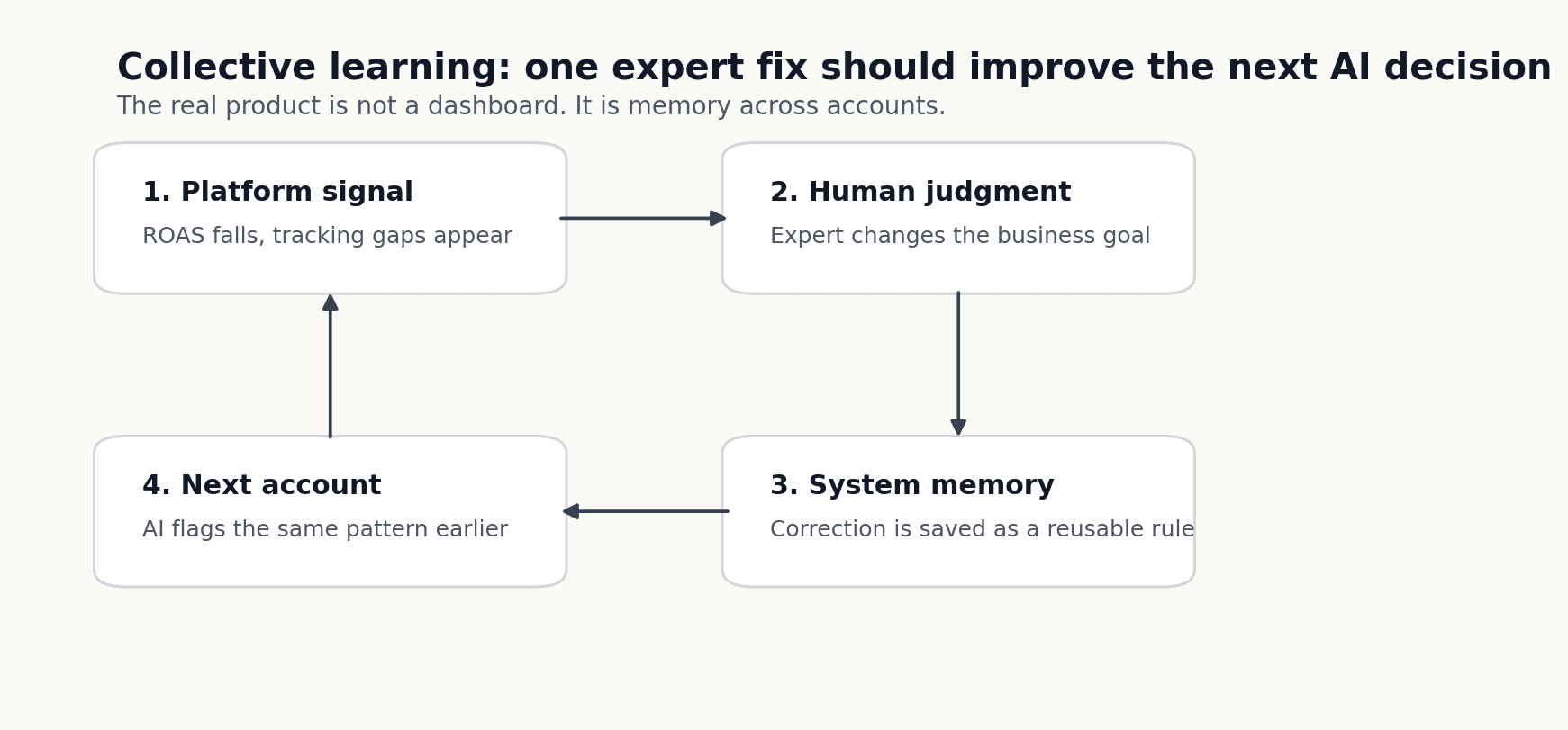
The real lesson is that every human correction should become system memory.
When an expert sees that a SaaS account is optimizing for stale conversion volume, that should not remain a private note in one consultant's head. It should become a reusable pattern:
- When ROAS drops while conversion volume stays active, inspect whether the conversion goal is stale.
- When branded search and product search have very different economics, separate them before judging the account.
- When the funnel includes signup, trial, and paid subscription, weight the events by business value instead of treating every conversion as equal.
- When tracking spans multiple domains or privacy regimes, verify the signal path before trusting campaign-level optimization.
This is what the next generation of AI growth systems should do.
Not just write ads.
Not just summarize dashboards.
Not just recommend another experiment.
They should remember where human experts had to intervene, then use that memory to catch the next stale-goal problem earlier.
This is where Auxora fits into the story.
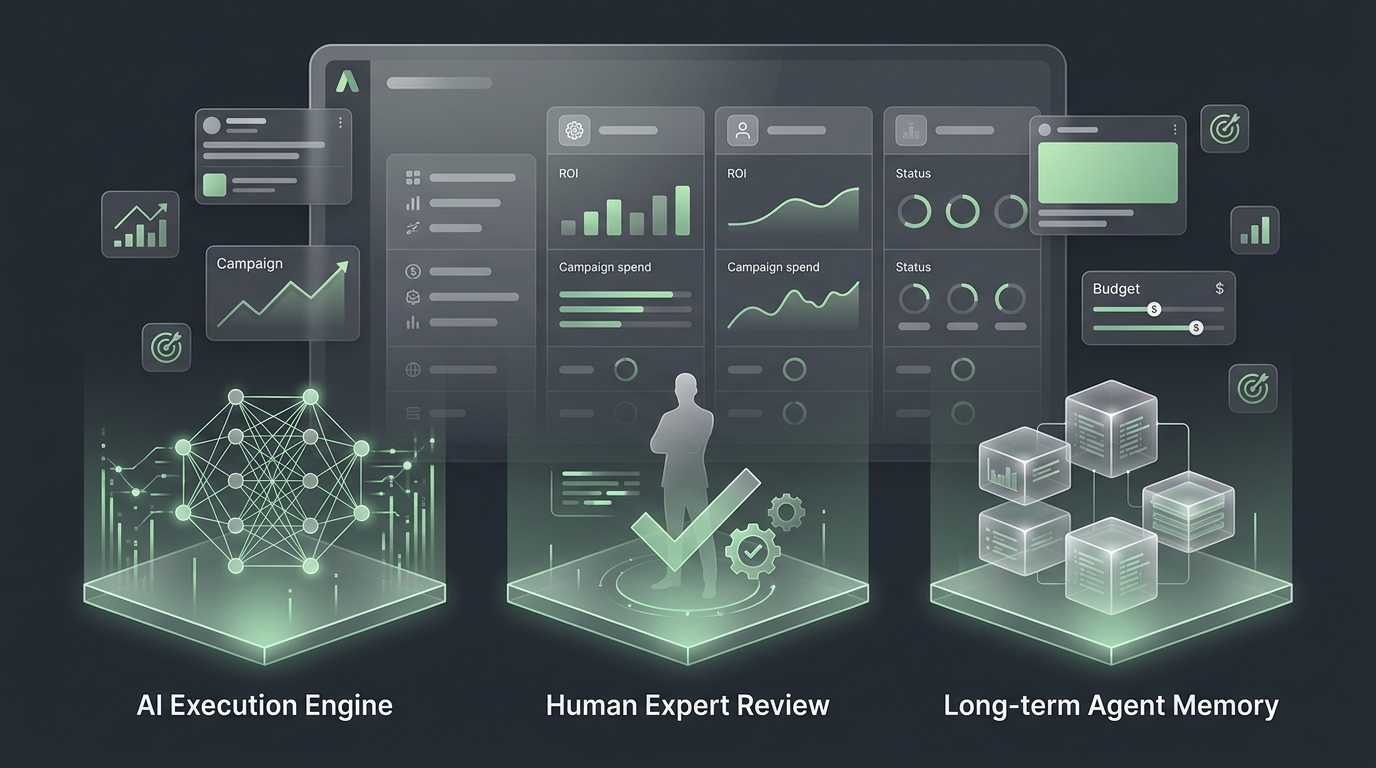
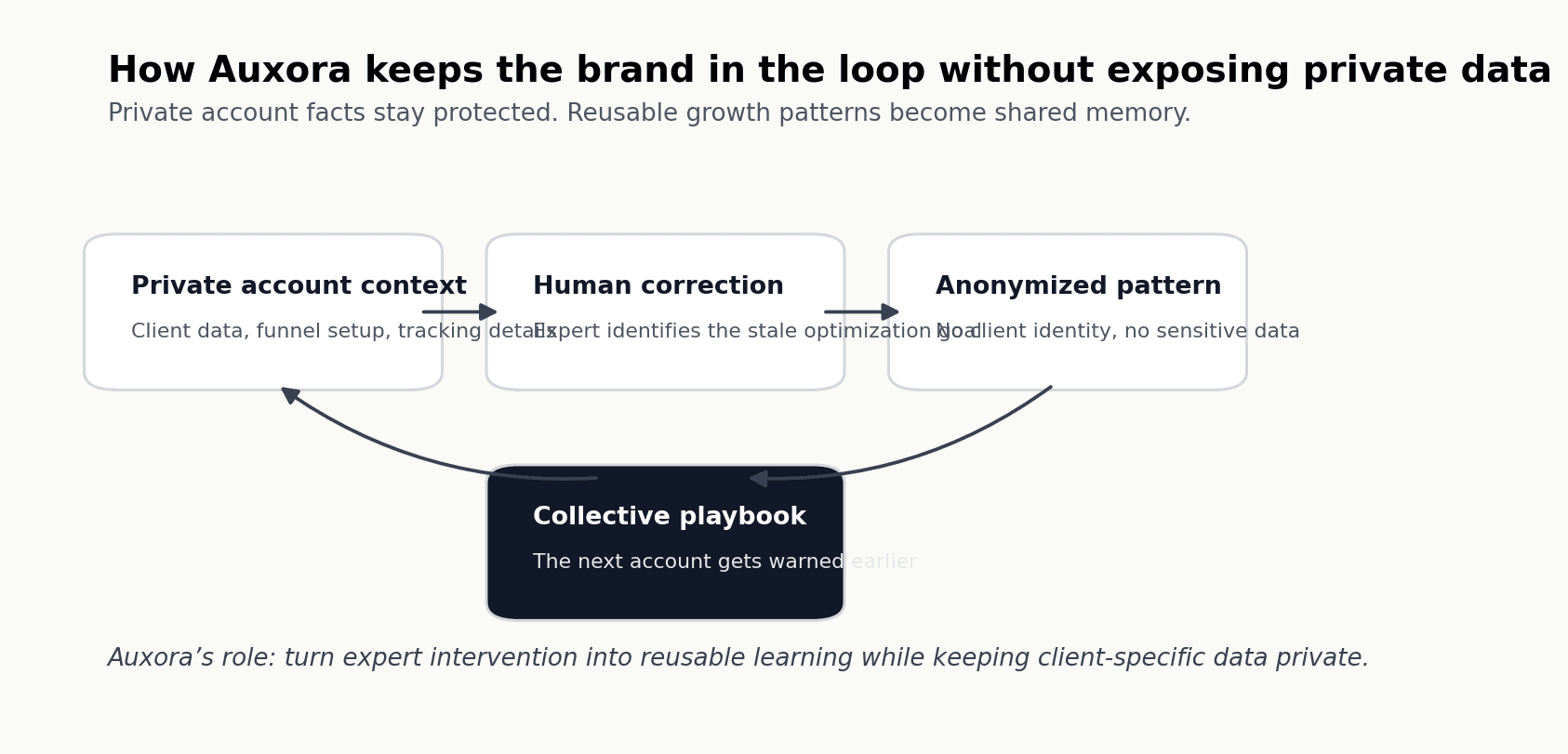
Auxora is not trying to replace the expert who notices that the goal is wrong. The point is to make that expert correction easier to capture, easier to reuse, and safer to share across future work.
The privacy line matters. A client's account data, funnel details, and business context should stay protected. What can be shared is the pattern: "ROAS is falling, conversion volume still looks active, and the account may be optimizing for a stale goal." That lesson can help the next team without exposing the original client.
That is the difference between a dashboard and a learning system. A dashboard shows what happened. Auxora is built to preserve the useful human judgment behind what happened, turn it into a reusable growth playbook, and apply it earlier next time without leaking private client information.
Google Ads can optimize the goal you gave it. A human expert can notice when the goal is wrong. Auxora's job is to help the system remember that correction and ask, much earlier next time:
"Are we still optimizing for the thing the business actually cares about?"